A Casino Film Discussion That Leaves Room for Different Readings
A casino film discussion helps teacher candidates trace framing, editing, and sound, then build a scene map that shows how filmmaking guides attention.
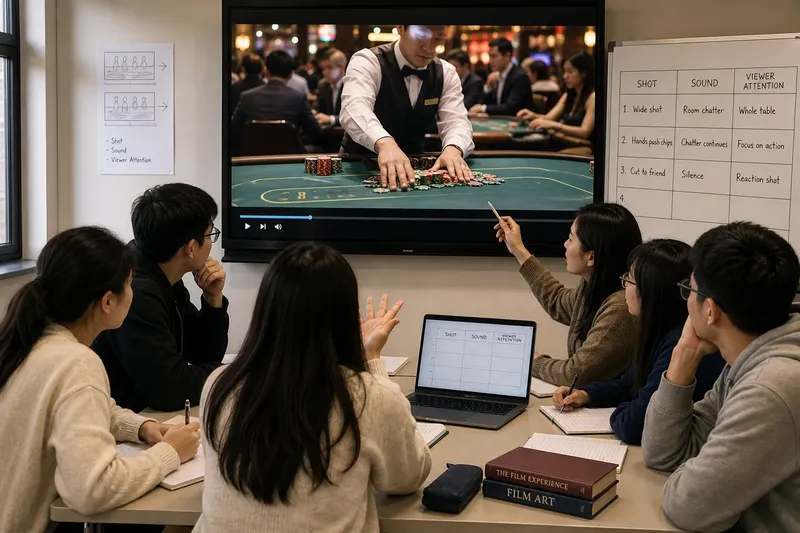
A student pauses a casino film just as a dealer sweeps chips aside. Around the room, classmates debate the player’s face, while the screen still holds on the table. That pause gives teacher candidates at Trường Đại học Sư phạm Hà Nội a chance to examine how framing, editing, and sound organize a viewer’s attention.
A casino film discussion can center on craft without turning into a lesson about gambling. Instead of trying to diagnose a character’s feelings, students can map the scene’s sequence: what enters the frame, where the edit takes them, and which sounds continue or disappear.
Map the scene
Choose a short, self-contained passage with a noticeable change in camera position, editing, or sound. Before class, check that the clip is suitable for the group, captions are available or can be supplied, and the audio is clear. Follow institutional rules for showing film.
Give students a simple scene map with three columns: shot, sound, and viewer attention. They can fill it in as they watch, recording visible details rather than guessing what a character thinks. This turns discussion into a comparison of film choices, not a contest over who can read a face correctly.
For example, a student might write “wide view of the table” in the shot column, “room chatter continues” in the sound column, and “several players remain visible” in the attention column. On the next line, a close-up might place one person’s hands at the center while the surrounding table disappears.
Track the camera
Ask what the camera includes, excludes, and returns to. A shot that keeps the dealer and players together gives viewers access to the group’s positions. A close-up can narrow attention to a hand, a face, or an object, while leaving other reactions unseen.
Then track the order of shots. Does the film show a gesture before a reaction, or cut to someone watching first? The order shapes what viewers notice, but it does not settle what a character feels or intends.
A camera frame is like a window with a movable shade: it opens attention onto some details and leaves others out of view. Students can use that idea to ask what the scene keeps beyond the frame, rather than treating the visible image as the whole event.
Hear the edits
Listen for changes in music, room chatter, speech, and small sounds such as chips clicking against a table. Ask students to mark whether each sound carries across a cut, stops before one, or begins with a new shot. That link between sound and edit gives them a concrete way to discuss rhythm.
If the clip is appropriate for it, replay a passage once with sound and once muted. Students can compare which details remain available in the image and which cues came from the soundtrack. Offer a transcript or another accessible response format when needed.
Compare film choices
Use the scene map to decide what further viewing or interpretation makes sense. Each item names an observable detail and a decision that follows from it.
- Check whether the shot shows the whole table. If several people are visible, compare their positions; if important people are outside the frame, mark their reactions as unavailable and avoid claims about them.
- Check which person receives a close-up. If the camera isolates someone, note the detail it emphasizes; if it stays wide, examine how the group shares the frame instead.
- Check when the edit falls in relation to a gesture. If the cut comes before it, track what the next shot prepares viewers to notice; if it comes after, compare the gesture with the reaction that follows.
- Check whether music or room sound changes around an action. If it shifts, mark the timing beside the edit; if it remains steady, look to framing or performance for another visible change.
- Check whether the film shows a reaction after a player moves. If it does, identify whose response enters the sequence; if it does not, leave that response unresolved rather than filling it in.
- Check whether captions identify dialogue and meaningful sounds. If a cue is missing or unclear, provide a transcript or describe it; if the captions are clear, compare their wording with the sound students hear.
Questions about film
Can students follow the scene without knowing the game?
Start with who acts, what changes in the image, and what sound accompanies the action. Explain a game-specific term only when the scene’s sequence depends on it.
How can discussion stay about filmmaking?
Ask students to point to a shot, cut, sound cue, or performance choice before offering a reading. If a claim has no moment in the scene to support it, keep it as a possibility rather than a conclusion.
What if students focus on who wins?
Ask how the film presents the outcome: which shot comes next, whose reaction is shown, and what happens to the soundtrack. Those choices bring attention back to the scene’s construction.
What are alternatives to speaking aloud?
Students can annotate a still, draw the shot order, or submit a short written scene map. These options keep the same film-language task without requiring an oral response.
Build a scene map
Say you are preparing an invented clip for class. It begins with a wide shot of a crowded table; a player pushes chips forward; the room sound stops; the film cuts to a friend watching. These are hypothetical starting details, not a scene from an existing film.
Give students four blank rows on a paper scene map. In the first row, they enter “wide shot” and “room chatter”; in the second, “hands push chips” and “chatter continues”; in the third, “cut to friend” and “silence.” They then draw an arrow from the action to the reaction shot and circle the sound change that accompanies the cut.
The completed map shows that the film moves from a group view to the player’s action, then to the friend’s response, while the room sound drops away. The class can decide that the sequence directs attention toward the friend’s reaction, but not that it proves what either person feels. If a later shot returns to the player, students can add it; if not, they leave that response unresolved.
Carry the method elsewhere
Teacher candidates can use the same scene map with a family conversation, a classroom exchange, or another short passage. Keep the columns focused on shot, sound, and viewer attention so students practice reading film form rather than importing casino props or game rules into a lesson.
A casino film discussion becomes more precise when students can reconstruct the order of what they saw and heard. The map also gives a quieter student a clear way to join in: point to a shot, mark a sound change, and explain what the sequence makes visible—and what it leaves open.