What a Casino Plot Teaches When No One Explains the Rules
Use a casino plot to teach dramatic tension through audience uncertainty, helping future teachers shape what viewers know, suspect, and discover in a scene.
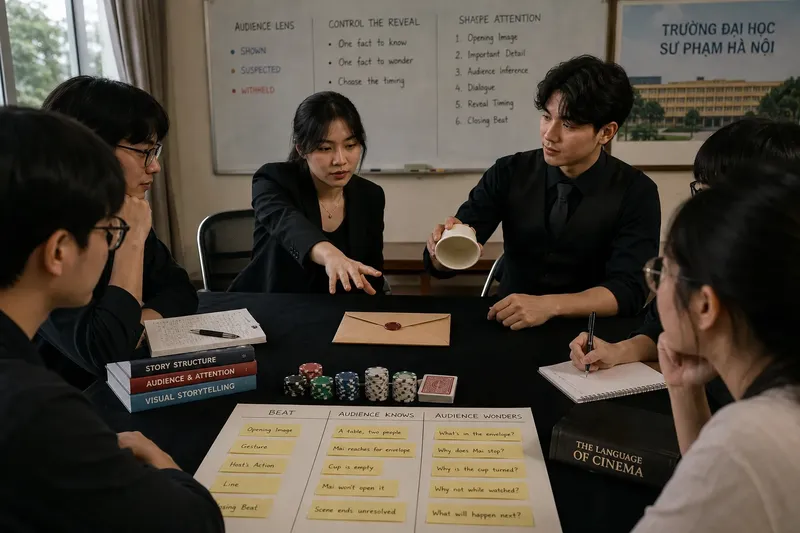
A character reaches toward a sealed envelope, then stops when the host turns over an empty paper cup. In a casino-inspired story, a classroom can explore how that small gesture changes what an audience suspects. For teacher candidates at Trường Đại học Sư phạm Hà Nội, the useful subject is not a map of who controls what; it is how a scene manages information and attention.
Audience knowledge
Writers decide what viewers can see, what they can infer, and what remains hidden. Those choices create suspense without requiring real casino procedures. A table, a card, or a closed envelope can serve as a stage image, while the story’s tension comes from the gap between what a character knows and what the audience knows.
Ask students to mark each beat as shown, suspected, or withheld. “Shown” is visible or spoken. “Suspected” is suggested by behavior or context. “Withheld” is information the scene deliberately keeps back. This vocabulary directs attention to the viewer’s experience rather than another inventory of character resources and consequences.
Control the reveal
Have students choose one fact the audience needs to understand and one fact the audience should wonder about. A host might openly announce that the envelope belongs to a guest, while concealing why the guest refuses to touch it. The first fact anchors the scene; the second gives viewers a question to carry through it.
Then ask when the concealed fact should become available. A reveal can arrive through dialogue, a prop, a change in behavior, or a pause. If every detail is explained at once, the audience has little to interpret. If nothing is made clear, uncertainty can become confusion. A good scene gives viewers enough footing to keep asking the intended question.
Shape audience attention
Use a simple three-column board: beat, audience knows, and audience wonders. The columns are not a story map. They are a record of the information handed to viewers as the scene unfolds.
- Opening image: Check whether viewers can identify the immediate situation. If they cannot, add a visible action or plain line; alternatively, keep the uncertainty but clarify whose perspective guides the scene.
- Important detail: Check whether the audience needs the detail now. If it supports the current question, show it; alternatively, delay it until the scene can make use of it.
- Audience inference: Check whether a gesture points toward a meaningful possibility. If several readings feel equally likely by accident, add a contextual cue; alternatively, make the ambiguity an intentional source of tension.
- Dialogue: Check whether a line repeats what viewers already understand. If it does, replace it with a reaction or new information; alternatively, keep the repetition only if a character’s insistence changes its meaning.
- Reveal timing: Check whether the scene answers its central question before interest has time to build. If it does, move the answer later; alternatively, introduce a new, clearly framed question after the reveal.
- Closing beat: Check whether viewers can tell what changed. If the ending feels indistinct, add a visible choice or reaction; alternatively, end on a deliberate unanswered question that the scene has prepared.
Audience questions?
How much should viewers know?
Give viewers enough information to follow the immediate action, then decide which uncertainty should hold their attention. If the audience cannot tell what is happening, withholding more information usually makes the scene harder to follow.
How can a prop create suspense?
Give the prop a clear visible role and let a character’s behavior suggest that it matters. A sealed envelope becomes interesting when viewers can see someone avoid opening it, even before they know why.
What is the difference between mystery and confusion?
Mystery gives viewers a specific question with incomplete information. Confusion leaves them unsure which question the scene is asking or what the characters are doing.
How can students revise a reveal?
Ask what viewers know immediately before and after the reveal. If the answer changes nothing in their understanding or attention, adjust the timing or make the information more consequential to the scene.
Worked scene revision
Imagine a student group begins with three invented details: one host, one guest named Mai, and one sealed envelope. Their first draft opens with Mai asking, “What is inside?” and the host replying, “A letter.” The group decides viewers should know the envelope contains a letter, but should wonder why Mai hesitates to open it.
First, they replace the question with Mai reaching toward the envelope and stopping. Second, they have the host turn the empty cup beside it rather than explain the hesitation. Third, they let Mai say, “Not while you’re watching.” The audience can now observe the letter and the pause, then infer that the host’s presence matters, without being told why. The group chooses to end the scene before explaining the reason, because its intended result is a clear question about Mai’s reluctance—not uncertainty about what the envelope contains.
Use the audience lens
This approach can help teacher candidates discuss suspense, point of view, and visual storytelling without treating casino culture as a set of instructions. It also gives students a focused revision question: what can viewers know at this moment, and what should they still be wondering?
When the class revisits a scene, keep the audience’s knowledge beside the script like a bookmark: it holds your place without changing the story. Trace one reveal from its first hint to its explanation, and check that each beat gives viewers a reason to keep watching.