The Lucky Break Myth in Casino Stories
The lucky break myth in casino stories can make chance look deserved. Use a weeklong classroom routine to examine how scenes frame a win and its meaning.
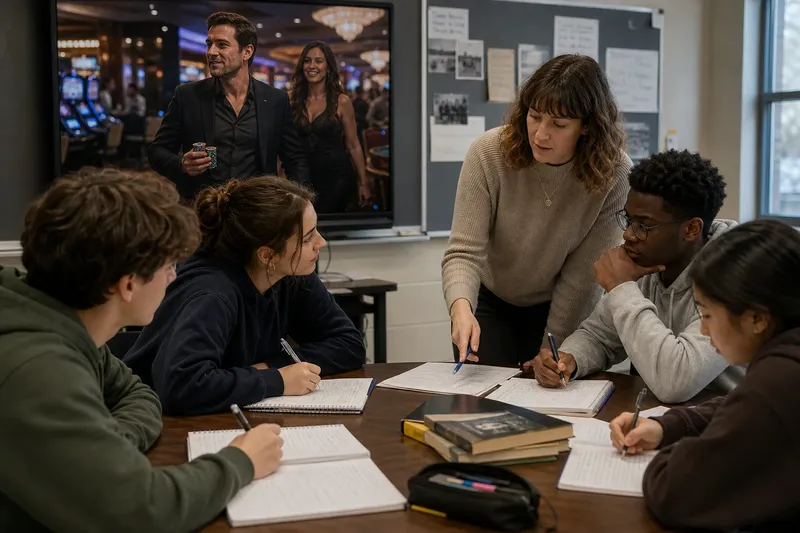
A character leaves a casino with chips in hand as music swells and a companion smiles. The lucky break myth in casino stories can make chance look like proof of talent or a deserved fresh start. In a classroom, a short, structured reading routine helps students examine how a story builds that impression.
A Weeklong Reading
Choose one short scene from a film, novel, or story the class already knows. Keep the focus on a single apparent win and the storytelling choices around it. Students can use notebooks or a shared document, working alone, with a partner, or as a class.
- Monday, mark the sequence: Note what happens before the apparent win, during it, and immediately afterward. If the scene provides clear actions and reactions, keep them in sequence; if it skips a key moment, mark that gap rather than filling it in.
- Tuesday, inspect the presentation: Revisit the camera, narration, dialogue, music, and reactions. If a cue steers the audience toward triumph or humor, record where it appears; if the cue is ambiguous, note the competing effect it could have.
- Wednesday, map the character’s choices: List what the character knows, chooses, and does not control. If the scene shows preparation or a deliberate decision, identify it; if it leaves the character’s knowledge unclear, keep that uncertainty open.
- Thursday, shape a claim: Write one sentence about what the win means in the story. If a specific scene detail supports the claim, cite it; if another detail complicates it, revise the claim to make room for both.
- Friday, change one choice: Alter the soundtrack, the next scene, or another character’s response. If the new version changes how the audience judges the win, explain the shift; if the judgment stays much the same, identify what else is doing the storytelling work.
This is a lesson in storytelling, not a way to predict gambling outcomes. A dramatic win can act like a shiny label on a jar: it attracts attention, but it does not tell you what is inside.
How Casino Stories Frame Luck
Preparation, confidence, and a risk-taking choice may make a win feel earned. The scene can show that a character acted boldly without establishing that the action caused the outcome. That distinction is enough for a focused discussion; students do not need to settle every question about the character.
Use a simple three-part note to keep the conversation anchored in the work:
- Scene detail: A line, action, image, sound, or consequence the story presents. If it can be pointed to in the scene, record it; if it is only a judgment, move it to the next category.
- Audience effect: A meaning the presentation encourages, such as triumph, embarrassment, or inevitability. If a detail helps create that effect, explain how; if it does not, leave it out of the claim.
- Open question: Information the scene does not provide, such as what might have happened under different circumstances. If the gap matters to the claim, qualify the claim; if it does not, keep the analysis focused on what the scene does show.
Say a student is reading an invented scene in which a character chooses a seat, wins shortly afterward, and receives a congratulatory nod. The student starts with those three details and claims the seat caused the win. They then check the scene: it shows the choice and the nod, but offers no link between the seat and the outcome. The student revises the claim to say that the scene invites viewers to connect confidence with success, while leaving the cause of the win unresolved.
Questions About Lucky Breaks?
What counts as a scene detail?
A scene detail is something the work presents, such as dialogue, an action, a sound cue, or a change in the character’s circumstances. “The win was deserved” is a judgment about those details, not a detail itself.
How does a story make a win feel earned?
Look at preparation, confident narration, approving reactions, and music that builds toward a payoff. Ask whether the scene connects those cues to the result or uses them mainly to guide the audience’s response.
Can luck still carry meaning?
Yes. A chance event may reveal what a character hopes for or how they respond afterward, even when the scene does not explain why the win occurred. Students can discuss that emotional meaning without treating it as proof of cause.
What if students disagree?
Invite each student to name a different scene detail and explain the reading it supports. If both readings fit the work, retain the disagreement; if one depends on a detail the scene never supplies, revise that claim.
After the Win
A lucky break may lead to loss, embarrassment, or a new problem. That turn can complicate the idea that fortune rewards good character, but it does not settle the question by itself. Ask what the later scene shows, how it is presented, and whether the story explains the reversal.
If the story ends in celebration, consider what it leaves outside the frame. Does anyone question the outcome? Does the character face a consequence? Is the ending offering a satisfying fantasy, making a claim about character, or doing both? Keep answers tied to this particular work rather than generalizing about every casino story.
Adapting the Lesson
For a short class period, combine the presentation and character-choice discussions. Younger readers can begin with “The scene shows…” and “The story invites me to think…”. More experienced students can compare the scene with a second portrayal that uses a different tone or ending.
Choose a brief extract that gives students something to examine without requiring a long plot recap. If casino content might feel uncomfortable, offer a fictional scene and do not ask students to share personal experiences. The discussion can stay with storytelling choices and classroom interpretation.
Reading the Payoff
The lucky break myth in casino stories becomes easier to discuss when students separate the scene’s craft from the conclusion it encourages. A useful closing note names one storytelling choice, the response it invites, and an uncertainty the work leaves open. That gives the next reader a clear place to begin without pretending the scene answers more than it does.