Using Casino Stories to Teach Scene Design
Casino stories help teacher educators teach scene design by tracing how entrances, objects, and withheld information shape a reader’s sense of space and choice.
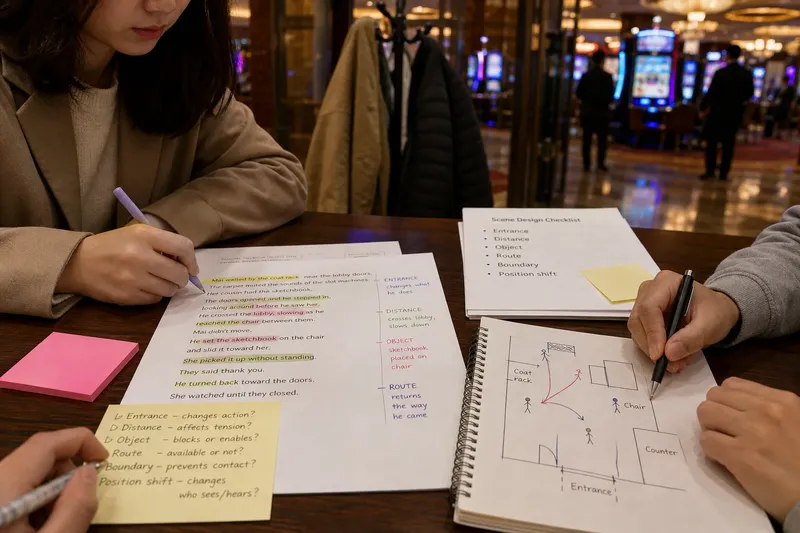
A student pauses at a casino lobby coat rack, then turns away from the exit. That small movement gives a class a concrete way to discuss how casino stories use scene design: the room matters because it changes what the character can do next.
Space as constraint
A setting becomes part of a scene’s design when it opens, limits, or redirects an action. A doorway can interrupt a conversation. A counter can keep two characters apart. A hallway can offer a route that someone refuses to take.
Think of the room like a chessboard: a piece’s position matters because it changes the moves available. In a story, however, the point is not to map every object. It is to notice which details affect a character’s choices and the reader’s understanding of those choices.
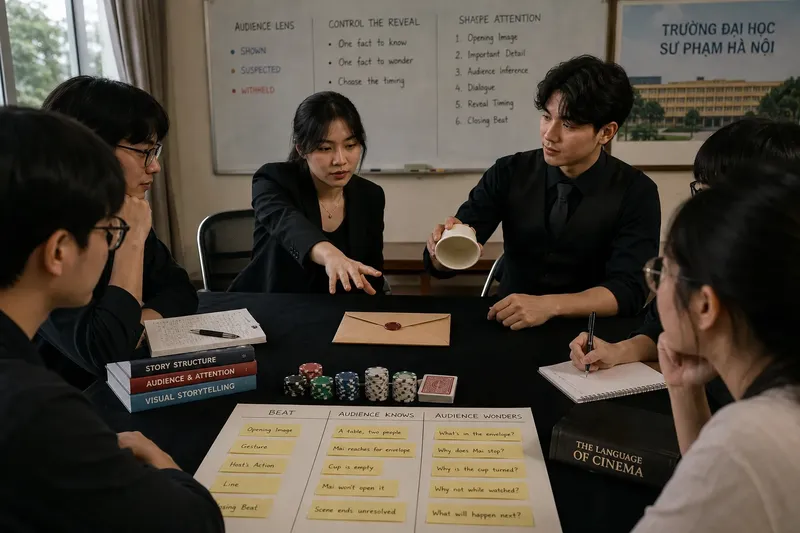
For teacher education at Trường Đại học Sư phạm Hà Nội, casino fiction can serve as material for discussing literary craft without turning a lesson into commentary on real-world play. Students can connect a spatial detail to an action, then explain what that detail contributes to the scene.
Trace spatial choices
Ask students to track people and objects at the moment something changes. A quick sketch, margin note, or set of arrows can reveal whether the prose establishes the scene’s physical logic. If a character’s location is unclear, consider whether the uncertainty creates an effect or simply makes the action hard to follow.
- Entrance: Check whether an arrival changes what someone says or does. If it does, keep the entrance and mark its consequence; if not, add a reaction or remove the arrival detail.
- Distance: Check whether the space between characters affects speech, access, or tension. If it does, retain the distance and name its effect; if not, clarify its purpose or cut the reference.
- Object: Check whether a chair, bag, or ticket changes hands or blocks a move. If it does, connect it to that action; if not, give it a clear purpose or omit it.
- Route: Check whether a character can use the nearest doorway or corridor. If the route is blocked and the character chooses another, show the consequence; if no choice follows, simplify the route description.
- Boundary: Check whether a counter, rope, or closed door prevents contact. If it does, explain what the boundary changes; if not, clarify why it is present or remove it.
- Position shift: Check whether a character’s movement changes who can see or hear whom. If it does, retain the move and show the new relation; if not, cut or revise the movement.
These are not boxes to tick for their own sake. Each observation should lead to a decision about the scene: keep the detail, clarify its effect, or remove it.
Work through a revision
Say a student drafts an invented scene in which Mai waits in a casino lobby while her cousin returns a borrowed sketchbook. The starting draft has three spatial facts: Mai stands near the entrance, the cousin is expected, and the sketchbook is not yet placed. The student adds that Mai waits beside the coat rack, has the cousin enter through the lobby doors, and places the sketchbook on a chair between them. The expected result is that readers can follow the arrival and see where the exchange happens; the tradeoff is less room for readers to imagine the room’s arrangement.
The student then compares the two versions. If the original already makes the exchange clear, the added blocking may be unnecessary. If readers cannot tell who arrives or where the book goes, the revision supplies information tied directly to the action.
Questions about scene design?
How does setting affect character choices?
Entrances, objects, and boundaries can open or limit a character’s options. Look for a specific action or refusal that follows from the spatial detail.
Should students draw a scene map?
A sketch can help when readers lose track of positions or movement. If the prose is already clear, a brief margin note may be enough.
How can teachers discuss casino fiction responsibly?
Keep the learning target on narrative craft, such as blocking, pacing, or point of view. Avoid asking students to disclose personal experiences, and do not present fictional activity as advice.
What if a spatial detail seems unnecessary?
Ask what changes if the detail disappears: a movement, a relationship, or the reader’s grasp of the action. If nothing changes, cut it or give it a clearer purpose.
Choose a teaching task
Use a short excerpt in which location affects what a character can do. Bring printed copies, pencils, and sticky notes. Keep the activity centered on one decision in the scene rather than on cataloging every feature of the venue.
- Read the excerpt aloud once without pausing to interpret it.
- Mark the entrances, exits, and objects connected to an action.
- Sketch the characters’ positions at the moment of a decision.
- Choose one spatial detail and state what it enables or prevents.
- Revise one sentence to clarify a movement, or remove a detail that has no effect.
- Compare the two sentences and describe the change in clarity or interpretive freedom.
The finished work is a marked excerpt and a revision students can explain. If a pair cannot connect its edit to an action, have them reread the surrounding lines and decide whether the change belongs.
Keep the lesson specific
A casino setting can provide the scene’s backdrop, but the lesson need not dwell on the venue. Select an excerpt because its arrangement of people or objects affects what happens, not simply because it takes place in a casino. If discussion turns toward judgments about real play, return to the writer’s choices about movement, access, and attention.
For teacher educators, the distinction is useful: the story supplies the setting, while the learning objective names the craft decision. Casino stories teach scene design most clearly when students can point to a position or boundary and explain how it changes the next available action.